
Deep learning is a subset of machine learning that uses multi-layered artificial neural networks to automatically learn complex patterns from large datasets, while machine learning is a broader field where algorithms learn from data to make predictions without explicit programming. The key differences are that deep learning requires much more data and computational power but can handle complex, unstructured data, whereas traditional machine learning models are more adaptable to smaller datasets and often require human feature engineering.
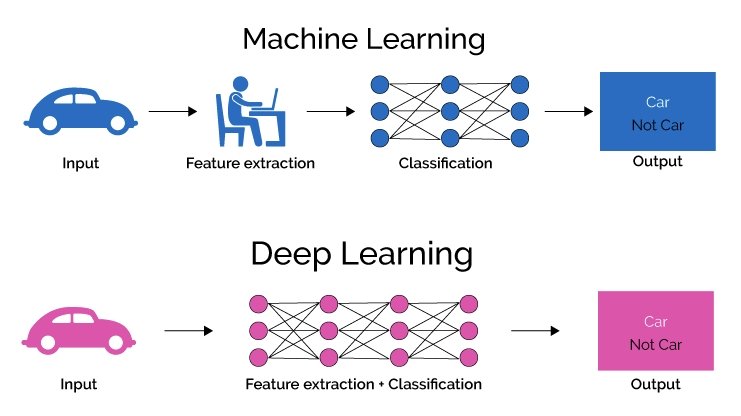
Machine Learning (ML)
Concept: A field of artificial intelligence that enables systems to learn from data and improve their performance on a task without being explicitly programmed.
How it works: Algorithms identify patterns in data to make predictions or decisions.
Human role: Often requires significant human effort to preprocess data and select relevant "features" (characteristics) that the algorithm should focus on.
Data needs: Can work with relatively small datasets.
Examples: Regression, classification, and clustering tasks.
Deep Learning (DL)
Concept: A specialized type of machine learning that uses multi-layered artificial neural networks, inspired by the human brain, to learn complex patterns.
How it works: Data passes through multiple "layers" of interconnected algorithms, with each layer transforming the data for the next.
Human role: Automates feature engineering; the neural network learns the important features directly from the data.
Data needs: Requires large volumes of data to train effectively.
Examples: Image recognition, speech recognition, natural language processing, and autonomous systems.
Key Differences in a Nutshell
Hierarchy: Deep learning is a technique within machine learning, which is itself a part of artificial intelligence.
Architecture: Deep learning uses deep neural networks with many layers, while machine learning encompasses a wider range of algorithms.
Feature Engineering: Machine learning often relies on humans to define features; deep learning learns features automatically.
Data Requirements: Deep learning needs much more data than traditional machine learning methods.
Complexity: Deep learning excels at complex tasks and with unstructured data (like images and audio).
Search Anything
Trending Now
zero balance account opening onlineYouTube premium subscription cost in india
Best places to live in the us
Pandi Muni Temple Timings
What was the old name of dehli?
Airpods pro 3
Onam story
Tourist places
Who is the real owner of google?
Tata Harrier Price and Images, Colours & Reviews
Cubbon park timing
How much percentage profit easily we can get in sharemarket
Tourist Places to visit in Goa
what is bureaucracy
r studio download
Find my iphone using icloud
how to save money
Who is the prime minister of India
How to apply for Government jobs in india
How much Mileage will Honda Hornet 160r Give