
RStudio is a popular IDE (Integrated Development Environment) for the R programming language.
It helps you write, run, and manage R code easily.
How to Download RStudio (Posit)
Step 1 – Install R First
You must install R before RStudio.
Download R from:
https://cran.r-project.org
Choose:
-
Windows
-
Mac
-
Linux
Step 2 – Download RStudio
Go to the official site:
https://posit.co/download/rstudio-desktop/
Click “Download RStudio Desktop” (Free version).
Choose your operating system:
-
Windows (.exe)
-
Mac (.dmg)
-
Linux (.deb / .rpm)
Install it like a normal software.
System Requirements (Basic)
-
Windows 10/11 or newer
-
macOS 11+
-
4GB RAM minimum recommended
After Installation
-
Open RStudio
-
It will automatically detect R
-
Start writing R code in the console or script editor
If you tell me your OS (Windows/Mac/Linux), I can give you direct step-by-step installation instructions.
Humanize 125 words
To check your IndiGo Airlines booking, follow these simple steps:
✈️ Check Booking on IndiGo Website
-
Go to the official website: www.goindigo.in
-
Click on “Manage Booking”
-
Enter:
-
PNR / Booking Reference Number
-
Last Name (as per ticket)
-
-
Click “Retrieve Booking”
You will see:
-
Flight details
-
Seat information
-
Baggage details
-
Option to download ticket
No, artificial intelligence (AI) does not think like a human; it simulates cognitive functions by processing vast amounts of data and identifying patterns, but it lacks consciousness, emotions, true comprehension, and subjective experiences. While AI can generate human-like outputs and perform complex tasks, its underlying process is based on algorithms and probabilities, not genuine understanding or self-awareness, making it a powerful tool rather than a true thinker.
Why AI doesn't think like a human
-
Absence of Emotions and Intentions:
AI systems are not driven by emotions or genuine intentions; their actions are based on programmed rules and data.
-
No True Understanding or Comprehension:
AI models arrange information based on patterns learned from their training data rather than understanding the meaning behind it.
-
Different Cognitive Processes:
While both human and AI systems use networks to process information, human cognition involves deep reasoning and comprehension, whereas AI relies on statistical probabilities and algorithms.
-
Lack of Consciousness and Self-Awareness:
Humans possess consciousness, the subjective experience of being aware of oneself and one's surroundings, which AI does not have.
How AI "thinks"
-
Pattern Recognition:
AI excels at identifying patterns within massive datasets to generate responses or make predictions.
-
Data-Driven Responses:
When asked a question, AI processes the query, analyzes the data it was trained on, and generates a response based on the rules and probabilities it has learned.
-
Simulation vs. Reality:
AI can simulate aspects of human thought and conversation, creating an illusion of intelligence, but this simulation doesn't equate to actual human thinking or understanding.
The Future of AI Thinking
-
Advancements in AI:
The field of AI is rapidly developing, and future systems may become more sophisticated.
-
Potential for Greater Complexity:
As research continues, AI could potentially outperform human intelligence in certain tasks, but this does not mean it will achieve human-like consciousness.
-
Integration of Human and AI Methods:
Combining the speed and breadth of AI with human comprehension and intuition could lead to significant advancements, creating "the best of both worlds".
It’s simple.
I’ll assume that you have few, if any late payments showing on your credit report. If there are a couple, don’t worry about it. As they get older, they’ll have less effect on your score. A 30-day late payment that happened two years ago will typically affect your score just a couple of points.
To maximize your scores, do the following:
- if you have any collection accounts newer than two years, arrange to pay them off. Negotiate with the creditors if possible, but pay them off. If they are older than two years, leave them alone. Changing the status from “open collection” from three years ago to “paid collection” this month will cost you dearly in points on your score.
- Pay all your credit cards down below 30% of the credit limit. Ideally, pay them off because of the high interest rates, but 30% is the magic number.
- If you plan to buy within 6 months and you have “thin” credit (few open accounts), consider applying for two or three other credit cards, even if one of them is a secured card. As long as the institution reports to all three bureaus, a secured card will have the same positive effect on your score as unsecured ones. Use them for your regular purchases and pay them off in full each month—carrying a balance is expensive and does not help your score in any way.
- Don’t close any revolving accounts. The older accounts are, the more they help your scores.
As I said: simple. Paying down revolving debt is the single fastest way to boost your scores.
The minimum credit score for a mortgage in the U.S. varies by loan type, with conventional loans typically requiring a 620 credit score, while FHA loans can allow for scores as low as 500. Other factors like down payment, income, and debt-to-income ratio also play a significant role in loan approval, and lenders consider the overall financial profile, not just the credit score
Credit Scores for Different Loan Types
- Conventional Loans: Most conventional loans require a minimum credit score of 620.
- FHA Loans: These government-backed loans can allow for a credit score as low as 500, though a 580 score is often required for a lower down payment.
- VA Loans: These loans have no minimum credit score, though they require a Certificate of Eligibility and other factors to be considered.
Factors Beyond Credit Score
While your credit score is a critical factor, lenders also evaluate your overall financial health, including:
-
Down Payment:
A larger down payment can sometimes help a borrower with a lower credit score qualify.
-
Income and Assets:
Lenders will review your income, assets, and debt-to-income ratio to ensure you can afford the mortgage payments.
-
Co-signer:
Adding a co-signer with a strong credit history can help you qualify for a loan.
How to Improve Your Credit for a Mortgage in USA
- Monitor Your Credit: Regularly check your credit report for accuracy.
- Strengthen Your Credit: Pay down existing debts and avoid opening new accounts before applying for a mortgage.
India to USA economy class flight prices are highly variable but can be found for as low as ₹26,841 for a one-way ticket and around ₹45,000 to ₹52,000 for round trips, with prices depending heavily on the specific route, travel dates, and how far in advance you book.
You can find current pricing by using flight comparison sites like Skyscanner, momondo, or KAYAK.
PyTorch Lightning is an open-source Python library that provides a high-level interface for PyTorch, a popular deep learning framework. It aims to simplify the process of training and scaling deep learning models by abstracting away boilerplate code and handling complexities related to multi-GPU training, distributed training, mixed precision, and other advanced features.
Key aspects of PyTorch Lightning include:
-
Hardware Agnostic:
Lightning enables users to debug models on a CPU and then seamlessly scale to GPUs, TPUs, or multi-node distributed setups with minimal or no code changes.
-
Boilerplate Reduction:
It automates common tasks such as logging, checkpointing, early stopping, and performance profiling, allowing researchers and engineers to focus on model development and experimentation.
-
Scalability:
PyTorch Lightning provides built-in support for various training strategies, including Distributed Data Parallel (DDP), DeepSpeed, and others, facilitating efficient training on large-scale datasets and models.
-
Flexibility:
While simplifying many aspects of deep learning, Lightning maintains a high degree of flexibility, allowing users to customize and override specific behaviors when needed.
-
LightningModule and Trainer:
The core components of PyTorch Lightning are the
LightningModule, which encapsulates the model, optimizer, and training/validation/test steps, and theTrainer, which orchestrates the entire training process.
-
Simplification of PyTorch:
It organizes PyTorch code into a more structured and modular format, reducing the need for manual handling of training loops, backpropagation, and device management.
PyTorch is an open-source machine learning library based on the Torch library, used for applications such as computer vision, deep learning research and natural language processing, originally developed by Meta AI and now part of the Linux Foundation umbrella.
Programming languages: Python, C++
Initial release date: September 2016
Developer(s): Meta AI
License: BSD-3
Operating system: Linux; macOS; Windows
Original author(s): Adam Paszke; Sam Gross; Soumith Chintala; Gregory Chanan
Platform: IA-32, x86-64, ARM64
Deep learning is a subset of machine learning that uses multi-layered artificial neural networks to automatically learn complex patterns from large datasets, while machine learning is a broader field where algorithms learn from data to make predictions without explicit programming. The key differences are that deep learning requires much more data and computational power but can handle complex, unstructured data, whereas traditional machine learning models are more adaptable to smaller datasets and often require human feature engineering.
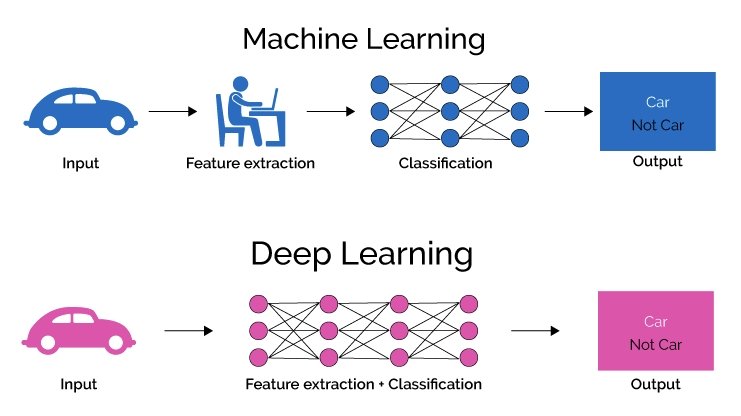
Machine Learning (ML)
Concept: A field of artificial intelligence that enables systems to learn from data and improve their performance on a task without being explicitly programmed.
How it works: Algorithms identify patterns in data to make predictions or decisions.
Human role: Often requires significant human effort to preprocess data and select relevant "features" (characteristics) that the algorithm should focus on.
Data needs: Can work with relatively small datasets.
Examples: Regression, classification, and clustering tasks.
Deep Learning (DL)
Concept: A specialized type of machine learning that uses multi-layered artificial neural networks, inspired by the human brain, to learn complex patterns.
How it works: Data passes through multiple "layers" of interconnected algorithms, with each layer transforming the data for the next.
Human role: Automates feature engineering; the neural network learns the important features directly from the data.
Data needs: Requires large volumes of data to train effectively.
Examples: Image recognition, speech recognition, natural language processing, and autonomous systems.
Key Differences in a Nutshell
Hierarchy: Deep learning is a technique within machine learning, which is itself a part of artificial intelligence.
Architecture: Deep learning uses deep neural networks with many layers, while machine learning encompasses a wider range of algorithms.
Feature Engineering: Machine learning often relies on humans to define features; deep learning learns features automatically.
Data Requirements: Deep learning needs much more data than traditional machine learning methods.
Complexity: Deep learning excels at complex tasks and with unstructured data (like images and audio).
While no payment gateway completely avoids GST (Goods and Services Tax) on all transactions, businesses without a GST number can use platforms like PhonePe and Cashfree Payments for individual or small-scale transactions and Razorpay for platform-specific features like selling on marketplaces without needing an upfront GST registration. For daily transactions, UPI payment apps like Google Pay and PhonePe are generally GST-free.

Search Anything
Trending Now
How much should I have in my emergency fundHow to get rid of Cockroaches in Kitchen Permanently
which payment gateway is best in india
Tata Nano 2025: Expected Price & Mileage
Economy of Karnataka
Tourist Places to visit in Pondicherry
how to refinance a mortgage in usa
Tell me about pregnancy week by week
Electric Bikes for Adults in USA
Audi q9 price in india
Verizon free iphone 13
How much percentage Returns we can expect in share market per week in equity swing trade
Which car gives the highest mileage
how to learn coding
Who Buyed Vijay TV Now
How to get rid of fruit flies
Government and administration of Karnataka
Pytorch lightning
Tourist Places to visit in Madurai
Which company has the lowest price for health insurance

Choose the Best Home Franchise Option for You

Home Services Franchise Marketplace
